

Global High-Performance Message Infrastructure Market to Hit USD 6.08 Billion by 2035, Led by IBM, AWS & Google Cloud.
High Performance Message Infrastructure Market
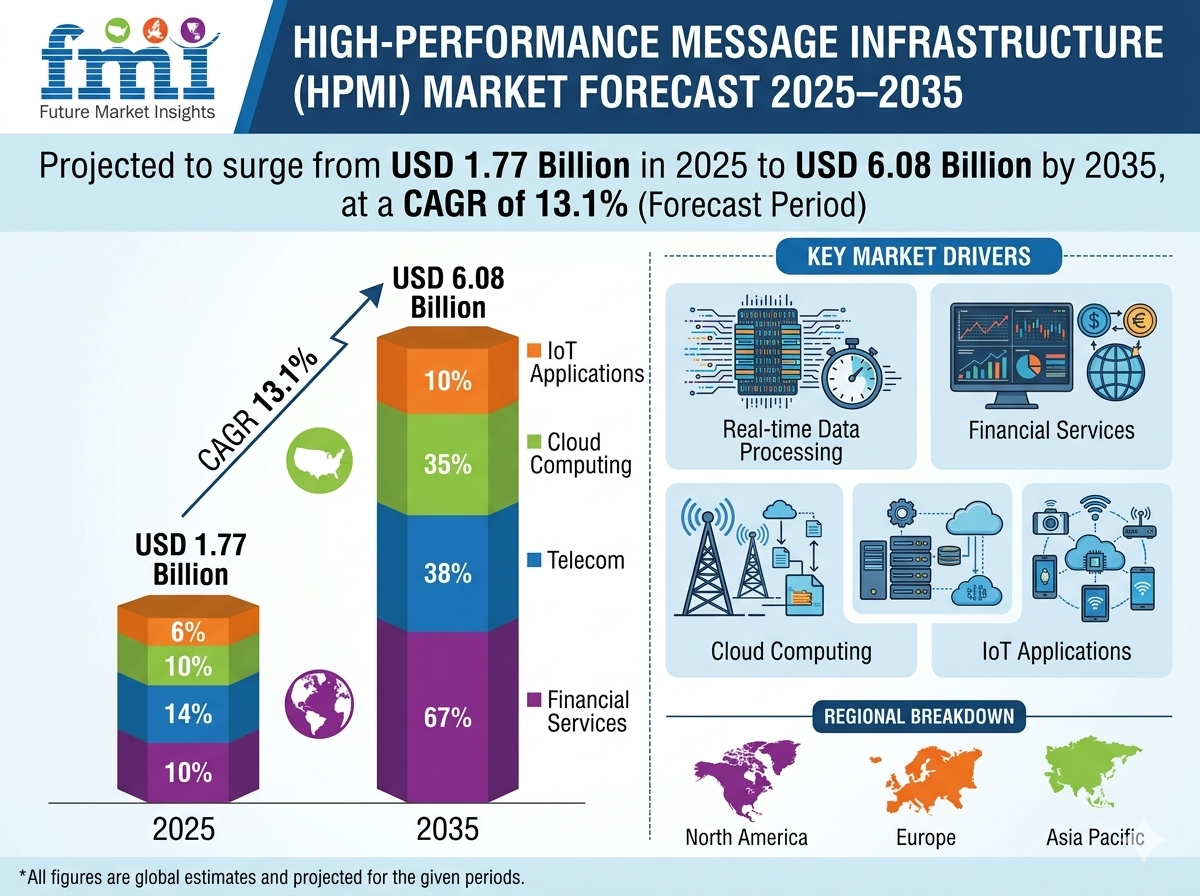
HPMI is projected to expand from USD 1.77 billion in 2025 to USD 6.08 billion by 2035 as finance, telecom, cloud, and IoT push ultra-low-latency messaging.
NEWARK, DE, UNITED STATES, April 1, 2026 /EINPresswire.com/ -- The global High-Performance Message Infrastructure (HPMI) Market is projected to grow from USD 1.77 billion in 2025 to USD 6.08 billion by 2035, advancing at a CAGR of 13.1% during the forecast period. Demand is accelerating as enterprises across financial services, telecommunications, cloud computing, e-commerce, and industrial IoT increasingly depend on ultra-low-latency communication and high-throughput message delivery.
As digital operations become more distributed and time-sensitive, HPMI is evolving from a specialized middleware layer into a core enabler of real-time business performance. It supports publish-subscribe messaging, event-driven architectures, and fast data serialization across hybrid cloud and multi-cloud environments, helping organizations move critical information with speed, consistency, and resilience.
Request For Sample Report | Customize Report | Purchase Full Report
https://www.futuremarketinsights.com/reports/sample/rep-gb-2778
High-Performance Message Infrastructure Market Snapshot (2025–2035)
• Market size in 2025: USD 1.77 billion
• Market size in 2035: USD 6.08 billion
• CAGR (2025–2035): 13.1%
• Leading component: Hardware
• Fastest-growing industry: Telecommunication
• Key use case leader: Financial trading and real-time analytics
• High-growth countries: India, China, the UK
• Leading companies: IBM, Microsoft, AWS, Google, Red Hat, Solace, TIBCO, Confluent, VMware, Huawei
Market Momentum
The HPMI market begins its forecast journey in 2025 with strong traction from financial trading platforms, cloud-native enterprises, and telecom operators managing increasingly complex data loads. Between 2026 and 2030, adoption widens as microservices architectures and API-based computing become standard across digital businesses that require seamless internal communication.
By the early 2030s, the market gains additional momentum from 5G rollouts, edge computing expansion, and the growing use of IoT-connected devices in automotive, manufacturing, smart city, and predictive maintenance environments. As autonomous vehicles, smart factories, and connected logistics networks generate massive volumes of time-sensitive data, high-performance messaging becomes essential for uninterrupted operations.
Toward 2035, vendors that combine low-latency architecture with strong encryption, compliance readiness, and scalable hybrid cloud integration are expected to dominate enterprise buying decisions. HPMI is no longer only about speed; it is increasingly about reliability, observability, and trust at scale.
Why the Market Is Growing
A major driver is the growing dependence on ultra-low-latency communication in high-frequency trading, fraud detection, algorithmic risk analysis, and real-time transaction processing. Financial institutions cannot afford delays measured in milliseconds, and HPMI provides the backbone for rapid message exchange across trading desks, payment systems, and analytics engines.
The shift toward cloud-native applications is another powerful catalyst. Modern enterprises are moving from monolithic software to loosely coupled microservices that require constant communication across distributed systems. Event-driven architectures, built on message brokers such as Apache Kafka, RabbitMQ, Pulsar, and ZeroMQ, are now central to operational agility in digital banking, e-commerce, gaming, and software platforms.
The market is also supported by the rapid deployment of 5G, edge computing, and industrial IoT. These technologies generate enormous streams of telemetry and event data that must be processed instantly. In automotive environments, for example, connected vehicles and driver-assistance platforms rely on fast messaging for sensor coordination, remote diagnostics, and next-step decision-making. In industrial automation, predictive maintenance and machine-to-machine communication depend on the same underlying infrastructure.
Segment Spotlight
1. Component: Hardware Leads the Market
Hardware is expected to hold the largest share at 47.8% in 2025. This reflects the demand for high-speed servers, FPGAs, NICs, and custom messaging appliances that enable millions of transactions per second. These systems are especially valuable in financial services, telecom, and cloud data centers, where every microsecond matters.
2. Industry: Telecommunication Surges Fastest
The telecommunication segment is projected to grow at a CAGR of 13.2% from 2025 to 2035. 5G rollout, IoT connectivity, and NFV are driving demand for messaging systems that can support smart city connectivity, AR/VR streaming, remote diagnostics, and network analytics.
3. Use Case: Financial Trading Remains a Core Anchor
High-frequency trading continues to be one of the most demanding use cases in the market. HPMI supports fast order execution, real-time risk checks, and market data distribution, making it essential for capital markets and digital brokerage operations.
Drivers, Opportunities, Trends, and Challenges
Drivers: rising digital payments, cloud migration, telecom modernization, and real-time analytics
Opportunities: AI-led automation, hybrid cloud messaging, serverless integration, and industrial IoT adoption
Trends: event-driven design, distributed microservices, publish-subscribe messaging, and edge AI workflows
Challenges: encryption overhead, data integrity, message consistency, and regulatory compliance in distributed systems
Security remains one of the most important differentiators. Enterprises must support GDPR, CCPA, and PCI DSS requirements without compromising latency. As cyber risks intensify, vendors that can combine performance with robust security controls will be best positioned to win enterprise trust.
Country Growth Outlook (2025–2035)
The United States remains a major market, supported by financial trading, cloud computing, and AI-driven enterprise adoption. Wall Street, hyperscale cloud platforms, and digital transformation initiatives continue to drive demand for low-latency messaging.
China is expanding rapidly due to 5G infrastructure, industrial IoT, and national digital investments. E-commerce, fintech, smart cities, and intelligent transportation are creating strong demand for high-throughput, real-time messaging layers.
India stands out as one of the fastest-growing markets with a CAGR of 14.4%. Digital payments, cloud adoption, fintech innovation, and telecom expansion are all accelerating demand for scalable messaging systems. Germany and the UK also show steady growth, supported by industrial digitization, enterprise modernization, and regulatory-driven infrastructure upgrades.
Competitive Landscape
The market is highly competitive, with IBM Corporation, Microsoft Corporation, Amazon Web Services, and Google LLC leading the enterprise cloud messaging space. Their platforms, including IBM MQ, Azure Service Bus, AWS Kinesis, and Google Pub/Sub, serve critical workloads in finance, telecom, and IoT.
Red Hat, Solace, and TIBCO focus on event-driven middleware and low-latency enterprise messaging. Confluent continues to strengthen its position through Apache Kafka-based real-time streaming, while VMware and Huawei support specialized deployments across enterprise virtualization and telecom-grade 5G environments.
Recent product enhancements across hybrid cloud, security, throughput, and serverless integration show that the market is entering a more mature phase. Competition is increasingly centered on speed, resilience, observability, compliance, and ecosystem depth.
Frequently Asked Questions
What is the market size of High-Performance Message Infrastructure in 2025?
It is valued at USD 1.77 billion.
How large will the market be by 2035?
It is projected to reach USD 6.08 billion.
What is driving adoption?
Financial trading, telecom, IoT, cloud-native applications, and industrial automation are the major growth drivers.
Which segment leads the market?
Hardware leads by component, while telecommunication is the fastest-growing industry segment.
Related Studies
Automated Guided Vehicles (AGV) Market - https://www.futuremarketinsights.com/reports/automated-guided-vehicles-market
AutomotiveAutomotive Wiring Harness Market - https://www.futuremarketinsights.com/reports/global-automotive-wiring-harness-market
AutomotiveTurboexpander Market - https://www.futuremarketinsights.com/reports/turboexpander-market
About Future Market Insights (FMI)
Future Market Insights (FMI) is an ESOMAR-certified, ISO 9001:2015 market research and consulting organization serving global enterprises across more than 30 industries and 1,200 markets worldwide.
Why Choose FMI:
https://www.futuremarketinsights.com/why-fmi
Sudip Saha
Future Market Insights Inc.
+1 347-918-3531
rahul.singh@futuremarketinsights.com
Legal Disclaimer:
EIN Presswire provides this news content "as is" without warranty of any kind. We do not accept any responsibility or liability for the accuracy, content, images, videos, licenses, completeness, legality, or reliability of the information contained in this article. If you have any complaints or copyright issues related to this article, kindly contact the author above.
