

Parental Control Software Market to Hit USD 4.2 Billion by 2036, Led by Asia with Qustodio, Norton & Bark Driving Growth
Parental Control Software Market
AI-driven monitoring, rising cyber safety concerns, and mobile-first adoption accelerate parental control software demand across global digital ecosystems.
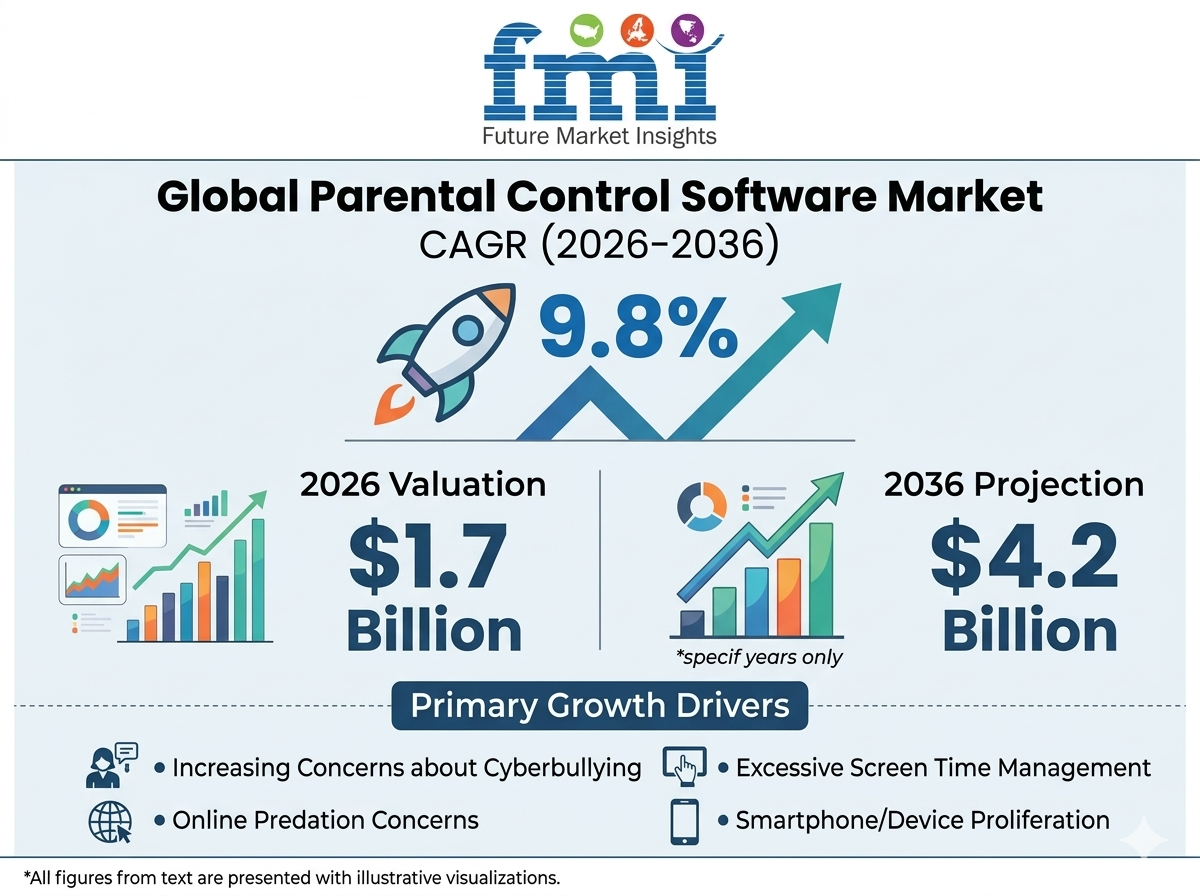
NEWARK, DE, UNITED STATES, April 2, 2026 /EINPresswire.com/ -- The global Parental Control Software Market is valued at USD 1.7 billion in 2026 and is projected to reach USD 4.2 billion by 2036, expanding at a CAGR of 9.8% during the forecast period. Growth is primarily driven by increasing concerns around cyberbullying, online predation, and excessive screen time, alongside the rapid proliferation of smartphones and connected devices among children.
As digital ecosystems continue to expand across education, entertainment, and social interaction, parental control solutions are evolving from basic content blockers into intelligent, AI-powered digital safety platforms. These tools now offer real-time monitoring, behavioral insights, and proactive threat detection, positioning them as essential components in modern digital parenting.
Request Sample Report | Customize Report | Purchase Full Report
https://www.futuremarketinsights.com/reports/sample/rep-gb-4111
Parental Control Software Market Snapshot (2026–2036)
• Market size in 2026: USD 1.7 billion
• Market size in 2036: USD 4.2 billion
• CAGR (2026–2036): ~9.8%
• Leading platform: Mobile-based solutions (61% share)
• Dominant device: Smartphones (64% usage share)
• Fastest-growing country: India (13.7% CAGR)
• Key companies: Qustodio, Net Nanny, Norton Family, Bark, Mobicip, FamilyTime
Market Momentum
The parental control software market begins its growth trajectory in 2026 at USD 1.7 billion, fueled by rising awareness of online risks and increased parental spending on digital safety tools. Between 2027 and 2030, adoption accelerates due to the widespread integration of AI-based monitoring, real-time alerts, and cross-platform compatibility across devices.
Entering 2032 and beyond, advancements in sentiment analysis, behavioral analytics, and predictive safety algorithms further enhance product capabilities. The expansion of e-learning, digital payments, and social media engagement among children reinforces demand for comprehensive monitoring ecosystems. By 2036, the market is expected to reach USD 4.2 billion, supported by strong adoption across households, schools, and telecom-integrated platforms.
Why the Market is Growing
The parental control software market is expanding rapidly as families seek more sophisticated tools to manage children’s digital exposure. The increasing penetration of smartphones at younger ages has created a pressing need for real-time monitoring and content filtering across multiple devices.
AI-driven innovations are transforming the landscape, enabling software to detect emotional distress, cyberbullying patterns, and predatory behavior through contextual analysis rather than simple keyword filtering. This shift toward intelligent monitoring significantly enhances parental trust and engagement.
Additionally, the rise of remote learning, gaming platforms, and social media ecosystems has increased screen time among children, prompting parents to invest in tools that ensure safe and balanced digital usage. Cloud-based dashboards and centralized control systems further simplify device management, making these solutions more accessible and scalable.
Segment Spotlight
1. Platform: Mobile-Based Solutions Lead
Mobile-based platforms dominate with a 61% market share, driven by the widespread use of smartphones as the primary internet access point for children. Real-time alerts and app-based controls enhance usability and adoption.
2. Device: Smartphones Drive Adoption
Smartphones account for 64% of total usage, reflecting early device ownership and constant connectivity among younger users. Monitoring social media and app usage remains a top priority for parents.
3. Features: Customization Enhances Retention
Customizable filtering and monitoring features improve user retention rates by nearly 15%, enabling parents to tailor controls based on individual needs and preferences.
Drivers, Opportunities, Trends, Challenges
• Drivers:
Rising cyber threats, increasing screen time, growing smartphone penetration among children
• Opportunities:
AI-based sentiment analysis, telecom bundling, cloud-based parental dashboards
• Trends:
Shift toward intelligent monitoring, cross-platform integration, digital wellness focus
• Challenges:
Privacy regulations (GDPR, COPPA), children bypassing controls, data security concerns
Country Growth Outlook (2026–2036)
India leads the market with a CAGR of 13.7%, driven by rapid smartphone adoption and digital education expansion. China (12.0%) and Japan (10.5%) follow with strong growth supported by regulatory frameworks and cyber safety awareness. The USA (9.2%) focuses on mental health-driven monitoring, while Germany (8.1%) emphasizes data privacy and compliance.
Competitive Landscape
The parental control software market is highly competitive, with leading players focusing on AI innovation, cross-platform compatibility, and enhanced user experience. Companies such as Qustodio, Norton Family, and Bark are investing in advanced analytics, real-time alerts, and predictive monitoring to differentiate their offerings.
Strategic partnerships with telecom providers and educational institutions are expanding market reach, while mergers and acquisitions are enabling companies to integrate advanced filtering technologies. Competition increasingly revolves around trust, reliability, and the ability to balance privacy with effective monitoring.
Frequently Asked Questions (FAQ)
What is the global Parental Control Software Market size?
The market is valued at USD 1.7 billion in 2026 and is projected to reach USD 4.2 billion by 2036.
At what rate is the market expected to grow?
It is expected to grow at a CAGR of approximately 9.8% from 2026 to 2036.
What is parental control software?
It refers to digital tools that help parents monitor, manage, and restrict children’s online activities across devices and platforms.
Why is parental control software gaining popularity?
Increasing cyber risks, rising screen time, and the need for digital safety are driving widespread adoption.
Explore More Related Studies Published by FMI Research
Turboexpander Market - https://www.futuremarketinsights.com/reports/turboexpander-market
Automotive Glass Market - https://www.futuremarketinsights.com/reports/automotive-glass-market
Industrial Battery Market - https://www.futuremarketinsights.com/reports/industrial-battery-market
About Future Market Insights (FMI)
Future Market Insights, Inc. (FMI) is an ESOMAR-certified, ISO 9001:2015 market research and consulting organization, trusted by Fortune 500 companies and global enterprises. With a strong presence across the U.S., UK, India, and the Middle East, FMI delivers data-driven insights and strategic intelligence across diverse industries and markets worldwide.
Why Choose FMI:
https://www.futuremarketinsights.com/why-fmi
Sudip Saha
Future Market Insights Inc.
+1 347-918-3531
rahul.singh@futuremarketinsights.com
Legal Disclaimer:
EIN Presswire provides this news content "as is" without warranty of any kind. We do not accept any responsibility or liability for the accuracy, content, images, videos, licenses, completeness, legality, or reliability of the information contained in this article. If you have any complaints or copyright issues related to this article, kindly contact the author above.
