

Automotive Software Market USD 500.18 Bn by 2032 at 6.9% CAGR | SDV & ADAS Redefine Mobility | Maximize Market Research
Automotive Software Market
The car is no longer sold, it is subscribed. Software has replaced steel as the ultimate competitive moat in the global automotive industry.
"The vehicle is no longer defined by its engine. It is defined by its code and the brands that own the software stack will own the future of mobility" says Maximize Market Research.”
ROCKVILLE , MD, UNITED STATES, April 14, 2026 /EINPresswire.com/ -- FROM ECU TO OPERATING SYSTEM: How USD 313.53 Billion in Automotive Software Is Scaling to USD 500.18 Billion as the Car Becomes a computer— Maximize Market Research
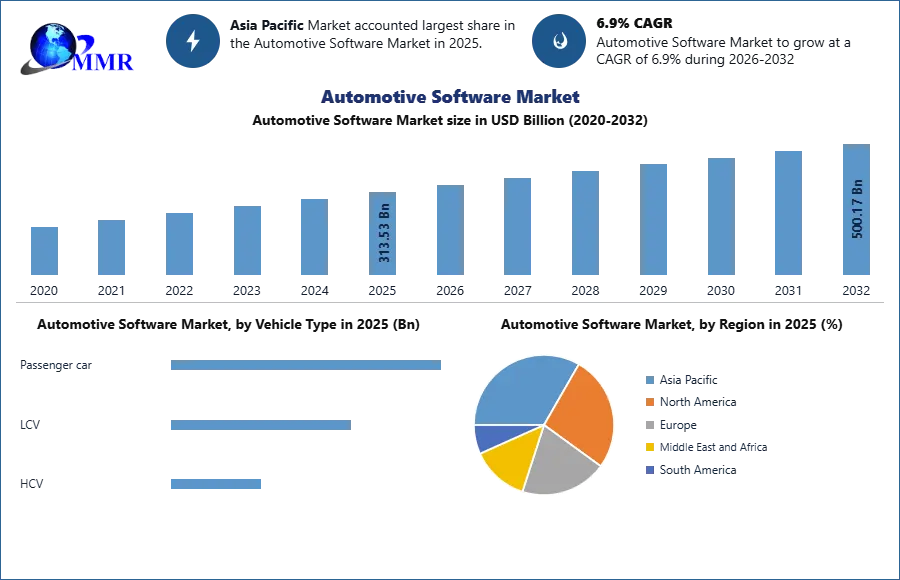
Global Automotive Software Market was valued at USD 313.53 Billion in 2025 and is projected to reach USD 500.18 Billion by 2032, expanding at a 6.9% CAGR. The structural shift from hardware-centric automobiles to Software-Defined Vehicles (SDV) is the defining megatrend of this decade. Vehicles today are no longer moving machines, they are rolling computing platforms, with electronic content already at 40% of total vehicle value and projected to exceed 60% by 2032. Advanced Driver Assistance Systems (ADAS), Connected Car Technology, Over-the-Air (OTA) Updates, and Vehicle-to-Everything (V2X) Communication are collectively converging into a software-first architecture that is rewriting every procurement decision across OEMs, Tier-1 suppliers, and technology platforms globally.
Get Full PDF Sample Copy of Report: (Including Full TOC, List of Tables & Figures, Chart) @ https://www.maximizemarketresearch.com/request-sample/22003/
THE SUBSCRIPTION SHIFT: From Metal to Recurring Revenue
The Global Automotive Software Market is driven by three compounding forces. Connected car ecosystems now require embedded AI and cloud-native development to manage terabytes of journey data. Simultaneously, massive 5G infrastructure investments in the EU and South Korea are shattering latency barriers for V2X communication. Finally, the Tesla-effect has proven that OTA monetization via recurring subscriptions is the future, forcing legacy OEMs to pivot R&D budgets toward proprietary Automotive Operating Systems (OS).
THE BARRIER: Compliance Costs vs. Infrastructure Reality
A "Structural Friction" exists where connectivity ambition hits technical and legal walls. Regulatory compliance, including ISO 26262 and NHTSA mandates creates grueling certification timelines that drain margins for new entrants. Furthermore, a lack of high-throughput connectivity in developing regions hampers OTA deployment. This capital-heavy landscape structurally favors established incumbents who already possess the Zonal Architecture and ECU consolidation expertise needed to navigate high-entry barriers and complex cybersecurity requirements.
THE UNLOCK: SDV Architecture and the AI-Powertrain Frontier
Growth through 2032 is anchored in three high-velocity corridors. SDV centralized computing is eliminating hundreds of distributed ECUs, making the Middleware layer the industry’s highest-margin segment. Meanwhile, EV powertrain software is surging, fueled by AI-enabled Battery Management Systems (BMS) and V2G integration. Finally, cloud-native development via AWS and Azure is enabling predictive maintenance ecosystems, drastically reducing fleet operational costs and establishing a new standard for long-term competitive advantage.
SEGMENT INTELLIGENCE: ADAS Commands Revenue, Application Software Commands Share, Passenger Cars Command Volume
The Global Automotive Software Market is segmented by vehicle type, application, software layer, and EV end-use. Passenger cars lead by vehicle type, driven by high software density in luxury models. ADAS & Safety systems represent the fastest-growing application, while Application Software held a 50.97% dominant share in 2026. Within EVs, Battery and Charging Management are high-velocity sub-segments, as cloud-native infotainment platforms redefine the digital in-vehicle experience.
By Vehicle Type
Passenger Car
Light Commercial Vehicle (LCV)
Heavy Commercial Vehicle (HCV)
By Application
ADAS & Safety Systems
Body Control & Comfort System
Powertrain System
Infotainment System
Communication System
Others
By Software Layer
Operating System
Middleware
Application Software
By EV End-Use
Charging Management
Battery Management
Vehicle-to-Grid (V2G)
Others
Get Full PDF Sample Copy of Report: (Including Full TOC, List of Tables & Figures, Chart) @ https://www.maximizemarketresearch.com/request-sample/22003/
THE DIGITAL DIVIDE: Scaling the Great Wall of Volume vs. Mapping the Silicon Blueprint
The Asia-Pacific "Goliath": A 1:1 Scale Revolution
Asia-Pacific isn't just participating in the market; it’s the gravity center of the automotive universe. Under the shadow of the “Made in China 2025” mandate, the region has mutated from a traditional assembly line into a live-fire testing range for V2X and autonomous algorithms. As the industrial titans of Japan and South Korea convert their massive fleets into software-defined vehicles, they aren't just building cars, they’re turning the planet’s largest automotive footprint into a sentient, connected ecosystem that runs on pure volume.
The North American "Architect": Engineering the Invisible DNA
While the East builds the body, North America is busy writing the soul. This isn’t about how many units move; it’s about who owns the digital DNA inside them. Driven by iron-clad NHTSA mandates like the 2029 AEB safety countdown, the region has turned regulatory pressure into a diamond-grade innovation cycle. With Silicon Valley’s heavy hitters (NVIDIA, Qualcomm) coding the future of cloud-native architecture, North America has cornered the market on the "brains" of the car, securing the elite cybersecurity and Level 3 autonomy margins that define the top of the food chain.
INDUSTRY RADAR: Four Seismic Developments Rewiring the Automotive DNA
The Perception Shift (NVIDIA): In early 2026, NVIDIA launched Alpamayo AI foundation models. By introducing multimodal perception and contextual reasoning, they set a new simulation-trained benchmark, effectively clearing the technical path for Level 4 Autonomy.
The Digital Twin Breakthrough (Siemens): Siemens debuted a Digital Twin platform enabling continuous virtual validation. This innovation slashes hardware-software integration risks and accelerates the industry’s pivot toward Centralized Zonal Architectures.
The Robotaxi Convergence (Lucid, Uber & Nuro): A massive collaborative platform debuted at CES 2026, integrating proprietary autonomous software with an EV chassis. This move validates Full-Stack Convergence and commercializes scalable software for urban Mobility-as-a-Service.
The Valuation Peak (Market Audit): As of early 2026, Application Software captured a 97% dominant share of the market. This reflects a massive industry-wide bet on connected services, projecting the global sector toward a USD 41.12 Billion valuation this fiscal year.
FIELD REPORTS: Software Logic in the Real World
NVIDIA Dominance: The DRIVE Orin SoC hit 15 million deployments, setting the 254 TOPS "gold standard" for Level 4 autonomy.
Ford’s SDV Validation: The F-150 Lightning’s Unified Compute Platform slashed wiring complexity by 35%, proving software-defined architecture works at mass-market scale.
Qualcomm Efficiency: The Snapdragon Ride Flex consolidated 12 ECUs into four controllers, delivering a massive 45% BOM cost saving.
Strategic Shift: These milestones confirm that silicon-level control and architectural consolidation are now mandatory for global automotive competitiveness.
COMPETITIVE MAP - Silicon Valley Platforms, German Tier-1 Incumbents, and Asian OEM Software Arms Dividing the Vehicle Brain
Global Automotive Software Market features a multi-tier structure led by Robert Bosch’s full-stack integration and NVIDIA’s computational dominance via the DRIVE platform. BlackBerry QNX remains the RTOS safety benchmark, while Google’s Android Automotive OS reshapes infotainment into platform-dependency models. Qualcomm and Continental drive ECU consolidation, whereas agile players like KPIT, Tata Elxsi, and Sonatus capture market share in high-growth cloud-native development and OTA updates, where innovation velocity outpaces legacy credentials.
Automotive Software Market Key Players:
Robert Bosch GmbH
Continental AG
BlackBerry Limited QNX
Google LLC Alphabet
Microsoft Corporation
NVIDIA Corporation
NXP Semiconductors N.V.
Intel Corporation
Infineon Technologies AG
Renesas Electronics Corporation
Aptiv PLC
DENSO Corporation
Panasonic Automotive Systems
LG Electronics Vehicle Solutions
HARMAN International
Get access to the full description of the report @ https://www.maximizemarketresearch.com/market-report/global-automotive-software-market/22003/
FAQs: Global Automotive Software Market
Q1. What is the current size and forecast of the Global Automotive Software Market?
Ans. The Global Automotive Software Market was valued at USD 313.53 Billion in 2025 and is projected to reach USD 500.17 Billion by 2032 at a 6.9% CAGR. Growth is driven by the Software-Defined Vehicle transition, 5G and AI integration, the proliferation of ADAS & Safety Systems mandates, and rising OTA-enabled software monetisation across passenger car and commercial vehicle segments.
Q2. Which region dominates the Global Automotive Software Market and why?
Ans. Asia-Pacific holds the largest market share during the forecast period, driven by the world’s highest vehicle production volumes across China, Japan, and South Korea, and the acceleration of China’s “Made in China 2025” strategy toward connected and autonomous vehicle software. North America leads in technology-driven revenue per unit, anchored by NHTSA AEB mandates, California’s Level 3 autonomy framework, and the concentration of NVIDIA, Qualcomm, and Google automotive platforms.
Q3. What are the key segments and growth drivers in the Automotive Software Market through 2032?
Ans. ADAS & Safety Systems is the highest-revenue application segment, while Application Software commands a 50.97% dominant share of the software layer. Key growth drivers include the shift from distributed ECUs to Zonal Architecture, the rise of cloud-native automotive development platforms, OTA-enabled feature subscription revenue, EV Battery Management and V2G software integration, and the deep learning expansion across driver monitoring, V2X communication, and infotainment middleware.
Analyst Perspective
The Global Automotive Software Market is decoupling from cyclical demand, shifting toward three strategic battlegrounds: SDV platform control, ADAS safety compliance, and cloud-native development. As North American tech leadership meets Asia-Pacific’s massive production volume, the industry is entering a high-conviction growth phase.Regulatory mandates from the NHTSA and EU are forcing compulsory procurement, while cloud giants establish unprecedented platform lock-in. Success through 2032 belongs to firms mastering Automotive OS, AI-enabled BMS, and OTA monetization, turning temporary innovation into permanent structural advantages in the global mobility ecosystem.
Related Reports
ADAS Market: https://www.maximizemarketresearch.com/market-report/global-advanced-driver-assistance-systems-market/2118/ ADAS Market by System (ACC, LDW, AEB, BSD), Vehicle Type, Sensor Type, and Region, Global Forecast to 2032
Connected Car Market: https://www.maximizemarketresearch.com/market-report/connected-car-market/8312/ Connected Car Market by Service (Safety, Navigation, Entertainment), Connectivity (5G/4G/3G), Vehicle Type, and Region, Global Forecast to 2032
Automotive Cybersecurity Market: https://www.maximizemarketresearch.com/market-report/automotive-cybersecurity-market/56573/ Automotive Cybersecurity Market by Security (Endpoint, Network, Application), Form (In-Vehicle, Cloud), Vehicle Type, and Region, Global Forecast to 2032
Electric Vehicle Software Market: https://www.maximizemarketresearch.com/market-report/electric-vehicle-software-market/219484/ Electric Vehicle Software Market by Type (BMS, OTA, Infotainment, ADAS), Vehicle Type, and Region, Global Forecast to 2032
Automotive Semiconductor Market: https://www.maximizemarketresearch.com/market-report/automotive-semiconductor-market/1892/ Automotive Semiconductor Market by Component (MCU, GPU, FPGA), Application (ADAS, Powertrain), Vehicle Type, and Region, Global Forecast to 2032
Top Reports:
Belt Sander Market
Bamboo Furniture Market
About Maximize Market Research Pvt. Ltd.
Maximize Market Research is a premier global consulting firm headquartered in Pune, India. Serving clients across 45+ countries, MMR delivers high-granularity market intelligence across Automotive & Transportation, Technology, and Consumer Goods, empowering enterprises with data-driven insights to make strategic decisions with confidence.
Domain Focus
This report falls under Maximize Market Research’s Automotive & Transportation domain, spanning automotive software, Software-Defined Vehicle platforms, ADAS & safety systems, connected car technology, and automotive cybersecurity across 45+ countries delivering the intelligence OEMs, Tier-1 suppliers, and technology investors need to navigate the evolving global automotive software landscape with precision through 2032.
Lumawant Godage
MAXIMIZE MARKET RESEARCH PVT. LTD.
+91 96073 65656
akash.r@maximizemarketresearch.com
Visit us on social media:
LinkedIn
Instagram
Facebook
X
Legal Disclaimer:
EIN Presswire provides this news content "as is" without warranty of any kind. We do not accept any responsibility or liability for the accuracy, content, images, videos, licenses, completeness, legality, or reliability of the information contained in this article. If you have any complaints or copyright issues related to this article, kindly contact the author above.
